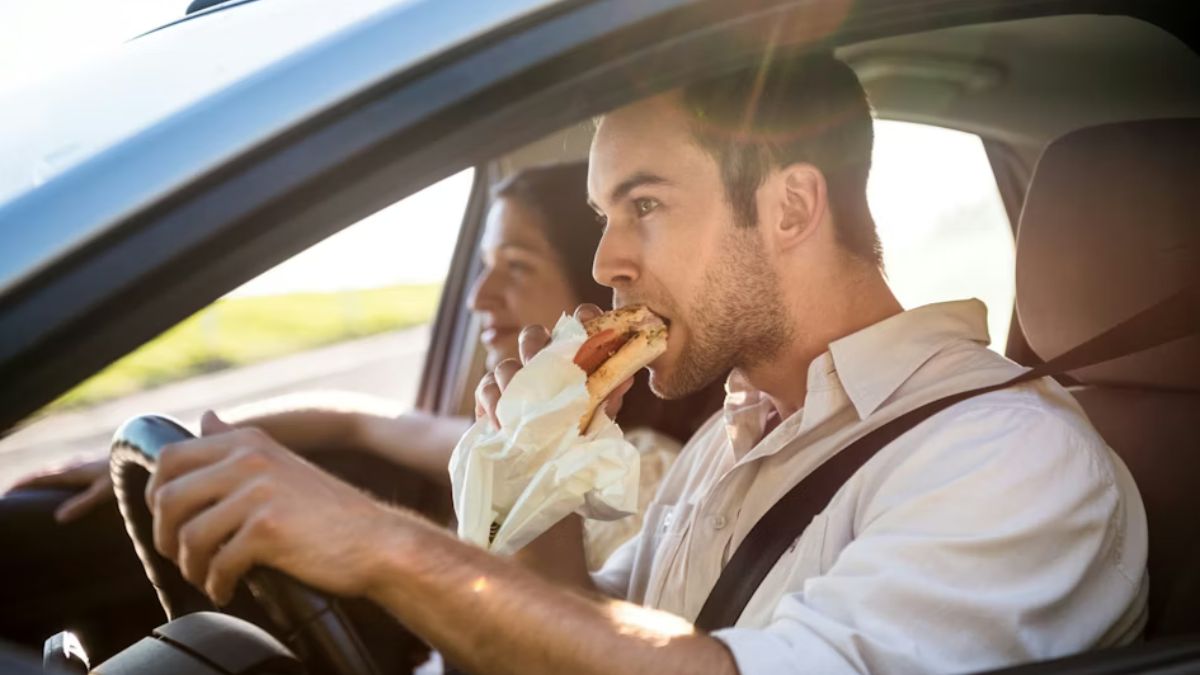
In a bold move to enhance road safety, Canadian authorities have introduced stricter distracted driving laws — and this time, the focus is on food. Eating while driving is now officially classified as a punishable offence in multiple provinces, with fines that could soar up to $10,000 in serious cases. This regulation marks a new era of enforcement where everyday behaviours, such as sipping coffee or grabbing a snack while on the move, are no longer tolerated behind the wheel.
Eating While Driving Now Considered a Legal Offence

Under the new rules, handling or consuming food while driving is now considered a form of distracted driving, joining the ranks of texting, mobile use, or adjusting in-car gadgets. According to Canadian road safety regulators, anything that diverts a driver’s attention — physically, visually, or mentally — is grounds for a fine or penalty.
Authorities have cited growing data showing that even brief distractions like unwrapping a sandwich or reaching for a bottle of water can lead to delayed reactions and severe accidents.
Latest Stories
 Canada Confirms 2026 Benefit Hike For Millions – More Money for Seniors, Families, and Low-Income Workers
Why Canada Introduced the Ban on Eating Behind the Wheel
The push for this policy stems from a worrying trend: distracted driving has overtaken impaired driving as a leading cause of fatal accidents in several provinces. Eating while driving ticks all three boxes of distraction:
- Physical distraction – One hand off the wheel to hold food or a drink
- Visual distraction – Eyes leaving the road to check or unwrap food
- Cognitive distraction – Mind focused on eating instead of driving
The government’s response? Clear penalties and a nationwide cultural shift toward more responsible driving habits.
New Penalties for Eating While Driving Across Provinces
Each province has implemented its version of the law with varying penalties. While $10,000 fines represent the upper threshold, even minor offences can cost drivers hundreds of dollars. Here’s a breakdown of penalties by province:
| Province/Territory | Fine Range (CAD) | Demerit Points | Licence Suspension | Notes |
|---|---|---|---|---|
| Ontario | $615 – $3,000 | 3–6 points | Suspension after 3rd offence | Escalating fines for repeat offenders |
| British Columbia | $368 – $3,000 | 4 points | Licence review for repeat offences | ICBC surcharges apply |
| Alberta | $300 – $5,000 | 3–5 points | Temporary suspension for repeated offence | Includes eating, grooming |
| Saskatchewan | $580 – $3,500 | 4 points | 7-day suspension on 2nd offence | Strong stance on distractions |
| Quebec | $300 – $6,000 | 5 points | Based on severity | Zero tolerance on distractions |
| Manitoba | $400 – $5,000 | 3 points | May require re-education | Eating now legally classified as distraction |
| Atlantic Provinces | $300 – $2,000 | 3–4 points | Possible suspension | Uniform laws being drafted |
| Federal Guidance | Up to $10,000 | Depends on case | Serious cases may lead to criminal charges | Injury or death escalates penalty |
How Eating Impairs Driver Reaction Time
Research from traffic safety institutes shows that eating while driving doubles the risk of a collision. The simultaneous distractions it causes — hands off the wheel, eyes off the road, mind on food — dramatically reduce a driver’s reaction speed.
Common culprits include:
- Coffee cups causing spills and panic responses
- Burgers and wraps requiring two hands or unwrapping
- Pastries creating messes that draw visual focus
In high-speed zones, even a two-second delay could mean the difference between braking in time and causing a crash.
Latest Stories
 Canada Confirms New Minimum Wages for 2026 – New Province Rates & Eligibility Revealed
What Law Enforcement Looks For
Police officers are now empowered to issue tickets for eating while driving based on observed behaviour. Key signs they assess include:
- Hands visibly off the steering wheel
- Eyes directed at food rather than the road
- Inconsistent speed or lane swerving
- Delayed reactions to road signals
Any action deemed to distract from safe driving, even if brief, is now grounds for enforcement.
Impact on Insurance Premiums and Records
A distracted driving charge, including one for eating, is now treated as a major offence by most insurance companies. Consequences include:

- Premium hikes between 25% to 100%
- Cancellation of existing coverage for repeat offenders
- Offences staying on your record for 3 to 6 years, depending on province
Some insurers may also require driver re-education courses as a condition for policy renewal.
How the Public Is Responding
Public reaction to the law is divided. While many road safety experts applaud the move, critics argue that it goes too far by penalising personal choices — especially during long drives or commutes.
However, education campaigns are underway to help Canadians adapt. Police forces and ministries are working to create awareness about what qualifies as distracted behaviour and why even small distractions can have large consequences.
Latest Stories
 Singapore Confirms $1,200 Support Payment for 2026 – Eligibility Rules, Cash vs Vouchers and Full Timeline
Government’s Justification: Saving Lives Through Behaviour Change
The core aim of the law is to reduce traffic injuries and fatalities. With distracted driving responsible for an estimated 20%–25% of all collisions in Canada, lawmakers see these penalties as a preventive measure.
The national alignment of laws signals a broader effort to:
- Standardise enforcement across provinces
- Send a clear message about zero tolerance
- Encourage mindful and focused driving habits
This is part of a wider policy agenda that includes updates to open work permits, digital driving licences, and retirement age changes — all under a banner of modernisation and safety
Latest Stories
 Canada Scraps Mandatory Retirement at 65 – What the New Two-Option System Means for Seniors
Clarifications and Legal Exceptions
While strict, the law does allow for certain exemptions:
- Eating while legally parked or fully stopped is not punishable
- Medical emergencies that require food or drink consumption may be exempt (proof required)
- Commercial drivers must still follow industry-specific meal and rest break regulations
However, eating at a red light or during a stop sign pause still qualifies as driving and can lead to fines.
Enforcement Tools and New Technology
Several provinces plan to enhance enforcement using:
Latest Stories
 Canada’s Open Work Permit Gets Tougher in 2026 – Full Breakdown of New Rules, TEER Limits, and Family Impact
- AI-enabled roadside cameras to detect eye and hand movements
- Spot checks and highway patrols
- Dashcam evidence submitted by third parties
Police may offer initial warnings for first-time minor infractions, but serious or repeat violations will face escalating fines and possible suspensions.
Penalty Levels Based on Offence Severity
Here’s how fines will be issued based on the situation:
| Offence Type | Description | Fine Range (CAD) | Consequences |
|---|---|---|---|
| Minor Violation | Eating with no immediate safety impact | $300 – $1,000 | Ticket and points |
| Moderate Violation | Eating causes erratic driving or close call | $1,000 – $5,000 | Insurance impact, higher penalties |
| Serious Violation | Eating leads to injury, damage, or death | $5,000 – $10,000 | Suspension, potential criminal case |
This tiered approach ensures fair penalties while discouraging high-risk behaviours.
Latest Stories
 $2,000 CRA Relief Payment Locked In for January 10 – Full Eligibility, Income Limits and Deposit Timeline Revealed
Long-Term Impact: Redefining Driving Culture in Canada
The ultimate goal of this law is cultural transformation. Canadians have long treated on-the-go eating as normal, especially during lengthy commutes. But with increasing risks and costs, authorities hope to redefine driving as a single-task activity.
By enforcing this policy, the government expects reductions in:
- Road crashes and injuries
- Emergency medical response burden
- Insurance claim volumes
- General driving stress levels
If successful, this law could become as impactful as past campaigns against drunk driving and texting behind the wheel.